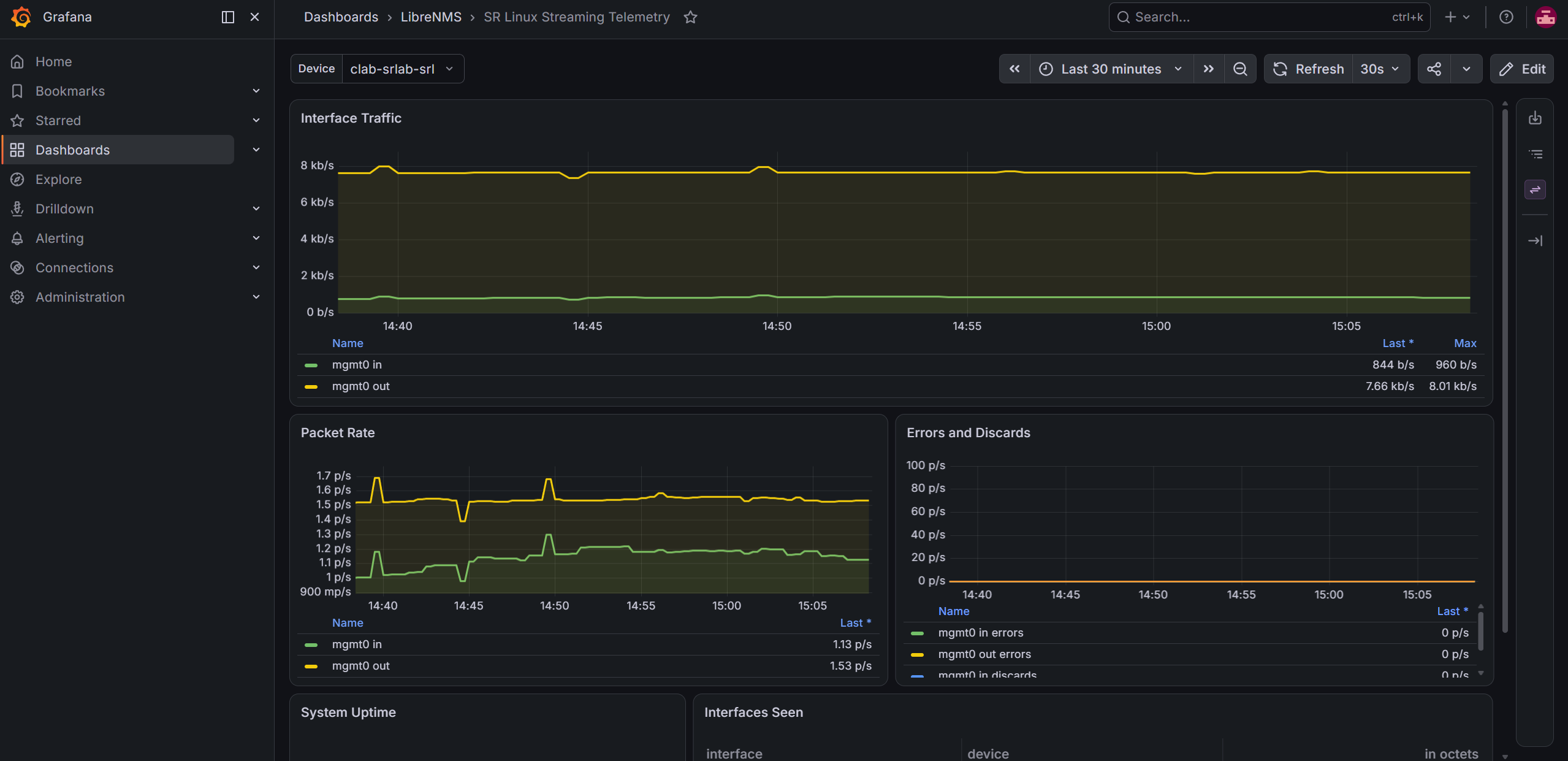
Note: This was originally requested 9 years ago, so I thought it would be best to start a new topic. Streaming telemetry is useful before it can provide very high level of detail (~10 seconds) without a large impact on the network devices. – Tristan
Feature idea: Streaming Telemetry Export
TL;DR — LibreNMS already knows which devices exist, what they are, and how they’re grouped. This feature would let it publish that as target config for an external streaming-telemetry collector (gNMIc first), the same way we hand device inventory to Oxidized. LibreNMS never touches the telemetry stream itself.
I’ve built a working reference implementation and validated it end to end with gNMIc against a Nokia SR Linux node, with SNMP and gNMI running side by side on the same device. Looking for feedback before proposing it seriously.
The idea
LibreNMS discovery → profile/policy resolution → desired-state API → gNMIc → your TSDB
Today, if you want gNMI streaming telemetry, you have to rebuild LibreNMS’s inventory by hand in gNMIc / Telegraf / OTel / scripts, and keep it in sync. LibreNMS already has the management address, OS, hardware, type, location, groups, and monitoring state. This replaces static target files and cron-driven API scripts with a first-class source of telemetry desired state.
Important: this is not metric storage. No telemetry passes through LibreNMS pollers. LibreNMS publishes target configuration only; the collector connects to devices, holds subscriptions, resolves credentials, and forwards data wherever the operator points it (Prometheus remote-write, VictoriaMetrics, Influx, Kafka, etc.).
Key principles
-
LibreNMS exports desired state; it does not run collectors.
-
SNMP stays the primary discovery/inventory mechanism.
-
Discovery and polling never block on gNMI, collectors, or telemetry backends.
-
Exports carry credential references, never device secrets.
-
Devices are candidates by default — enabling telemetry is explicit (per device or via device-group policy).
-
Internal model is collector-neutral; gNMIc is just the first renderer.
How it works
-
LibreNMS discovers a device over SNMP.
-
Local profile resolution (OS + hardware + version + groups) marks it a telemetry candidate — no network calls.
-
An admin or group policy enables it and assigns platform / subscription / transport / credential / collector-group profiles.
-
LibreNMS exposes the target over an API (plus optional CLI/file export).
-
gNMIc polls the endpoint, resolves credentials locally, and subscribes.
Version-controlled profiles ship in-tree (e.g. a Cisco IOS-XE OpenConfig profile with match rules, default port, recommended subscriptions, expected models), with local overrides. Subscription defaults are conservative: narrow OpenConfig paths, moderate intervals, no root-container subscriptions.
What the export looks like
Collector-neutral canonical API:
GET /api/v0/telemetry/v1/targets
gNMIc-native HTTP loader endpoint:
GET /api/v0/telemetry/v1/export/gnmic?collector_group=campus-main
{
  "core-sw1": {
    "address": "10.10.1.11:9339",
    "subscriptions": ["openconfig-interfaces-30s", "openconfig-system-60s"],
    "tags": ["librenms_device_id=123", "site=main-campus", "role=core"]
  }
}
Credentials are resolved collector-side (env / Vault / K8s secrets / etc.). Collector groups keep every collector from subscribing to every device, and targets stay exported through outages — they’re removed only when telemetry is disabled or the device is decommissioned.
Rough scope for a V1
Feature flag (off by default) · candidate detection + explicit enable · device-group policy · versioned platform/subscription profiles · collector groups + credential references · canonical JSON API · gNMIc endpoint · CLI/file export · revisions/hashes + conditional requests · preview & validation.
Explicitly out of scope: running/restarting collectors, config changes, credentials in responses, arbitrary server-side templates, streaming through pollers, storing telemetry, or picking a metrics backend.
Questions for the community
-
Does the Oxidized-style split (LibreNMS = inventory/policy, collector = runtime) feel right here?
-
Is gNMIc the right first target, or should another collector come first?
-
Where should the enable/disable UI live? device Settings/Edit, alongside Modules and SNMP?
-
Interest in in-tree platform/subscription profiles vs. leaving those to operators?
Happy to share the full design doc and the reference implementation if there’s interest.